




All our surveyors are RICS and MRICS qualified.
Comprehensive RICS Property Surveys & Structural Inspections Across London
Damp Specialist delivers professional property surveys, building condition appraisals and guaranteed damp remediation solutions across London and throughout the M25 ring.
Our surveying team combines strict RICS inspection standards with hands-on building pathology expertise. Whether you are acquiring a home, planning major structural alterations, managing an estate, or resolving ongoing moisture and movement concerns, our single-page service guide below outlines what each inspection covers, who it is best suited for and what you can expect from your final report.
RICS Property Valuation
A RICS Property Valuation is an objective assessment of a property’s market value, conducted by a suitably qualified RICS Registered Valuer. It provides an independent appraisal of what a home or building is reasonably worth based on current market dynamics, physical location, dimensions, structural condition and recent verified comparable sales.
Who It Is Suitable For
This service is designed for homeowners, property purchasers, sellers, property investors and individuals requiring an accurate, formal property valuation for financial or legal requirements. RICS valuations are usually needed for property purchases, open-market sales, inheritance tax calculations, probate administration, matrimonial asset settlements, shared ownership staircasing, Help-to-Buy redemptions and related financial proceedings.
What You Can Expect
During the survey, the valuer inspects the property, evaluates its general physical condition, reviews its construction type and layout and analyses relevant local market evidence. Considerations such as nearby transaction values, local property demand, recent home improvements and identifiable defects may influence the final figure.
Following the inspection, a written valuation report will be prepared explaining the assessed market value and detailing the evidence base on which that valuation was established. A RICS valuation is different from a full building survey; its core purpose is to determine market value rather than provide an exhaustive investigation into structural defects or ongoing maintenance liabilities. The resulting report delivers an evidence-based valuation to support major financial and legal decisions.
RICS Level 1 Condition Survey
A RICS Level 1 Home Survey (previously termed a Condition Report) is designed to deliver a clear, straightforward assessment of the overall physical condition of a residential property.
Who It Is Suitable For
Designed primarily for relatively modern bungalows, flats and houses built with standard construction techniques and maintaining good general order, this survey level offers an ideal solution. It allows buyers to obtain an independent evaluation of the property’s overall condition before committing financially, avoiding the need for the more in-depth diagnostic procedures involved in higher-tier inspections.
What You Can Expect
The survey delivers a professional visual inspection of the primary accessible elements of the building fabric, covering walls, roofs, ceilings, floors, windows, doors and related architectural components. The surveyor identifies visible defects, signs of ongoing deterioration and any issues requiring urgent rectification or additional specialist evaluation.
A simple traffic-light condition rating system is applied to explain the condition of individual building elements, ensuring the conclusions are clear:
- Green: Indicates no current significant concerns identified.
- Amber: Identifies defects requiring attention or scheduled maintenance.
- Red: Highlights serious, urgent, or hazardous problems.
The final report also documents key safety risks and issues that warrant secondary professional consultation. A Level 1 survey does not typically include detailed repair advice, specialist testing, or a property valuation.
RICS Level 2 HomeBuyer Survey
A RICS Level 2 Home Survey (previously termed a HomeBuyer Report) delivers a more detailed appraisal of a property’s condition than an entry-level survey.
Who It Is Suitable For
This inspection is particularly suitable for conventional houses, flats and bungalows that are generally in reasonable condition and have not undergone major structural modifications or extensions. The findings help prospective buyers gain an accurate picture of property health, identify impending maintenance outlays and make well-founded financial decisions before moving forward.
What You Can Expect
During the survey, both internal and external accessible areas are examined, including walls, roofing, ceilings, floor surfaces, doors, windows, visible utilities and drainage systems. The surveyor evaluates the structural fabric for issues like damp, condensation, rot in timbers, structural cracks, defective roofing, blocked or leaking gutters and general maintenance needs. Where standard concealed voids, such as basements or roof spaces, are safely accessible, they may be included in the inspection.
Defects are categorised using a traffic-light rating system to highlight their relative severity. Moving beyond a Level 1 assessment, a Level 2 report offers actionable advice on essential repairs, ongoing maintenance commitments and specific concerns that might necessitate further specialist diagnostic investigation. Clients can choose a Level 2 survey as a standalone service or opt to include a market valuation alongside an insurance reinstatement calculation.
RICS Level 3 Building Survey
A RICS Level 3 Home Survey (previously known as a Building Survey) represents the most comprehensive inspection available within the standard RICS residential framework.
Who It Is Suitable For
This survey level is strongly recommended for older period houses, substantial residences, non-standard architectural designs, properties in poor condition and buildings that have undergone significant structural alterations or previous extensions. It is equally suitable for buyers planning extensive structural refurbishments or major internal renovations. A Level 3 survey is valuable for buyers who require a complete understanding of a property’s condition and future repair commitments before making a major financial commitment.
What You Can Expect
A Level 3 inspection involves an extensive examination of accessible internal and external components, including roof structures, chimneys, main walls, visible foundations, floors, ceilings, structural timbers, external drainage and key building systems. The surveyor evaluates visible defects, structural deterioration, signs of building movement, dampness, wood decay and related fabric risks.
The comprehensive report provides detailed breakdowns of all identified defects, explaining their probable root causes, the consequences of leaving them untreated and appropriate repair or maintenance solutions. Where necessary, the surveyor may recommend targeted specialist investigations to confirm the depth of concealed problems. The report also outlines repair priorities, expected timescales and future maintenance considerations.
Structural Survey – Structural Condition Assessment
A Structural Survey is a specialist, detailed assessment focusing exclusively on the structural condition and load-bearing stability of a building.
Who It Is Suitable For
This investigation is tailored for properties exhibiting visible symptoms of structural movement, significant cracking, settlement, subsidence, foundation degradation, or other issues threatening the building’s structural stability. A structural condition assessment is valuable prior to completing an older property purchase, executing major structural renovations, removing internal load-bearing walls, or investigating suspected movement issues.
What You Can Expect
The inspection examines core structural elements, including load-bearing walls, floors, roofs, supporting structural beams, columns, masonry and visible foundation-related defects. The surveyor forensically checks for evidence of movement, physical distortion, fabric deterioration and structural irregularities that point to underlying ground or building problems. Particular attention is given to significant cracks, uneven floors, bulging brickwork, roof deformation and indications of previous structural modifications.
Where structural concerns are identified, the report explains their engineering significance, potential causes and whether secondary technical investigations are required. Recommendations may detail structural monitoring schedules, supplementary investigations, specialist repair works, or a full appraisal by a structural engineer. Unlike standard RICS home surveys, a structural inspection can be targeted to specific elements or examine the entire building. The exact scope is agreed in advance; structural calculations and engineering designs require a qualified structural engineer.
Specialised Laboratory Testing Add-Ons

4K Drone Roof Survey
Price £199 + VAT
Description: An aerial structural inspection employing ultra-high-definition 4K drone cameras to evaluate roof coverings, chimney stacks, flashings, rainwater goods and external elevated fabric. The survey captures clear photographic and video records of visible defects, wear, weathering and required maintenance in areas unreachable or hazardous to inspect from the ground.
Value: Supplies clear, documented photographic and video evidence of external building envelope faults without requiring direct physical access or the considerable cost of scaffolding. It allows penetrating damp sources to be identified at high levels so that external repair works can be planned accurately.
This service can be beneficial when:
- Chimney stacks, flashings, parapet walls, or roof coverings cannot be fully inspected from street level.
- Penetrating damp, moisture ingress, or staining appears on high-level ceilings or chimney breasts.
- Gutters, valleys, or downpipes are suspected of overflowing or discharging water into external brickwork.
- Evaluating older, period, or multi-storey properties before purchase or external maintenance.
- Visual proof of external building defects is required before undertaking remedial repairs.

Laboratory Mould & qPCR DNA Analysis
Surface swab or lift samples are submitted to an accredited laboratory for advanced qPCR DNA testing to identify exact mould species and spore concentrations.
Why it matters: Identifies toxigenic species (e.g., Stachybotrys chartarum) and concealed mould growth behind dry lining or furniture.
Diagnostic value: Establishes whether mould contamination is localised or widespread, enabling precise environmental remediation planning.
This service may be beneficial where:
- A persistent musty smell is present
- Mould repeatedly returns after cleaning
- The property has experienced previous water damage
- Contamination is suspected behind furniture or inside cupboards
- Occupants have concerns about the indoor environment
- The extent of visible mould is unclear
- Independent laboratory evidence is required
Note: The results can help establish whether contamination appears isolated or more widespread. They may also assist with planning appropriate cleaning, removal, drying, ventilation or moisture-control measures. Laboratory mould testing does not replace the need to investigate the moisture source. Mould is normally a symptom of excess moisture, condensation, leakage or inadequate ventilation, so the underlying cause must also be identified. If we carry out the recommended work, the survey fee will be deducted from the cost of that work.
Mould Air Quality Testing (Air Pump Test)
Price £299 + VAT
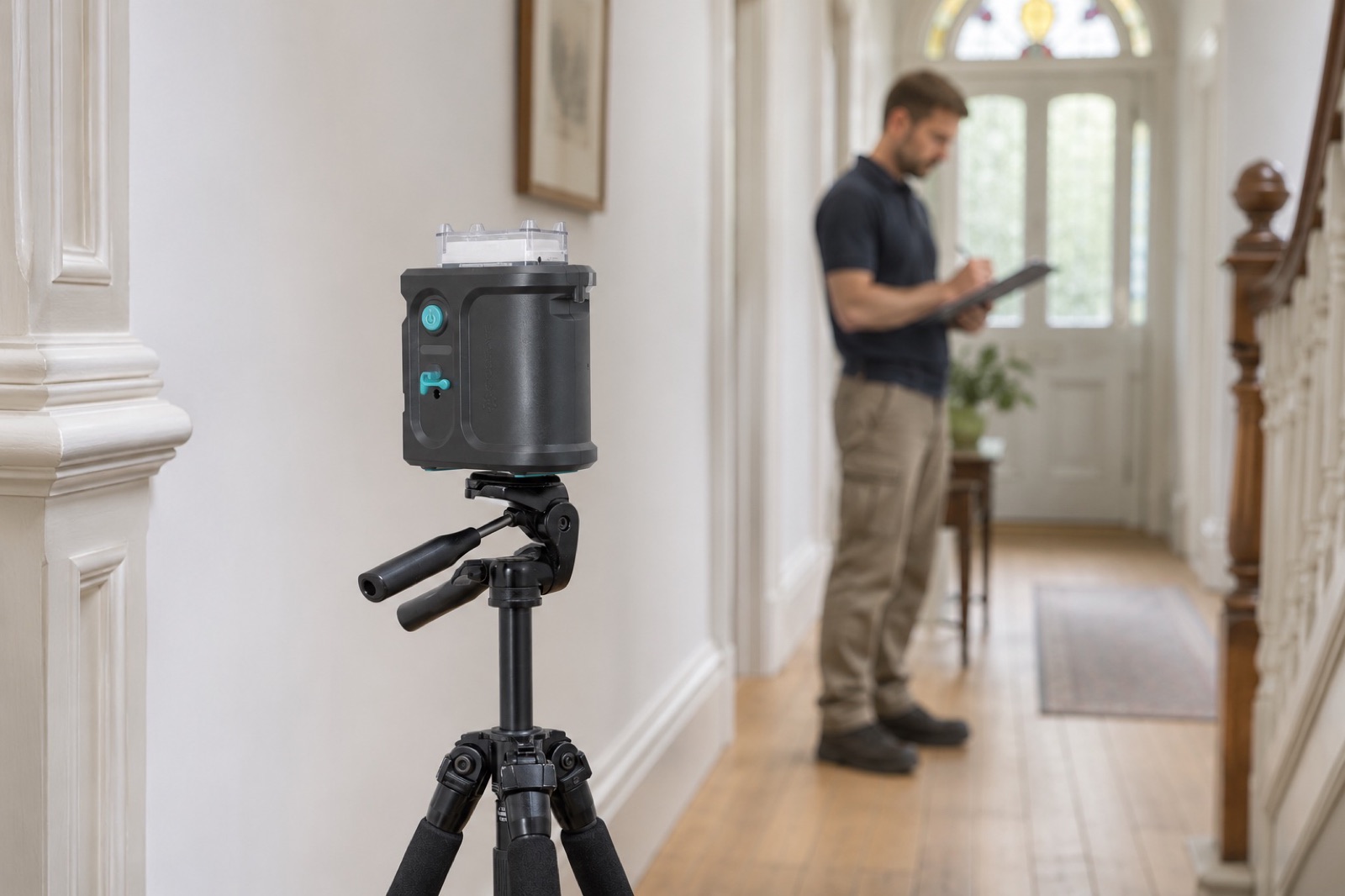
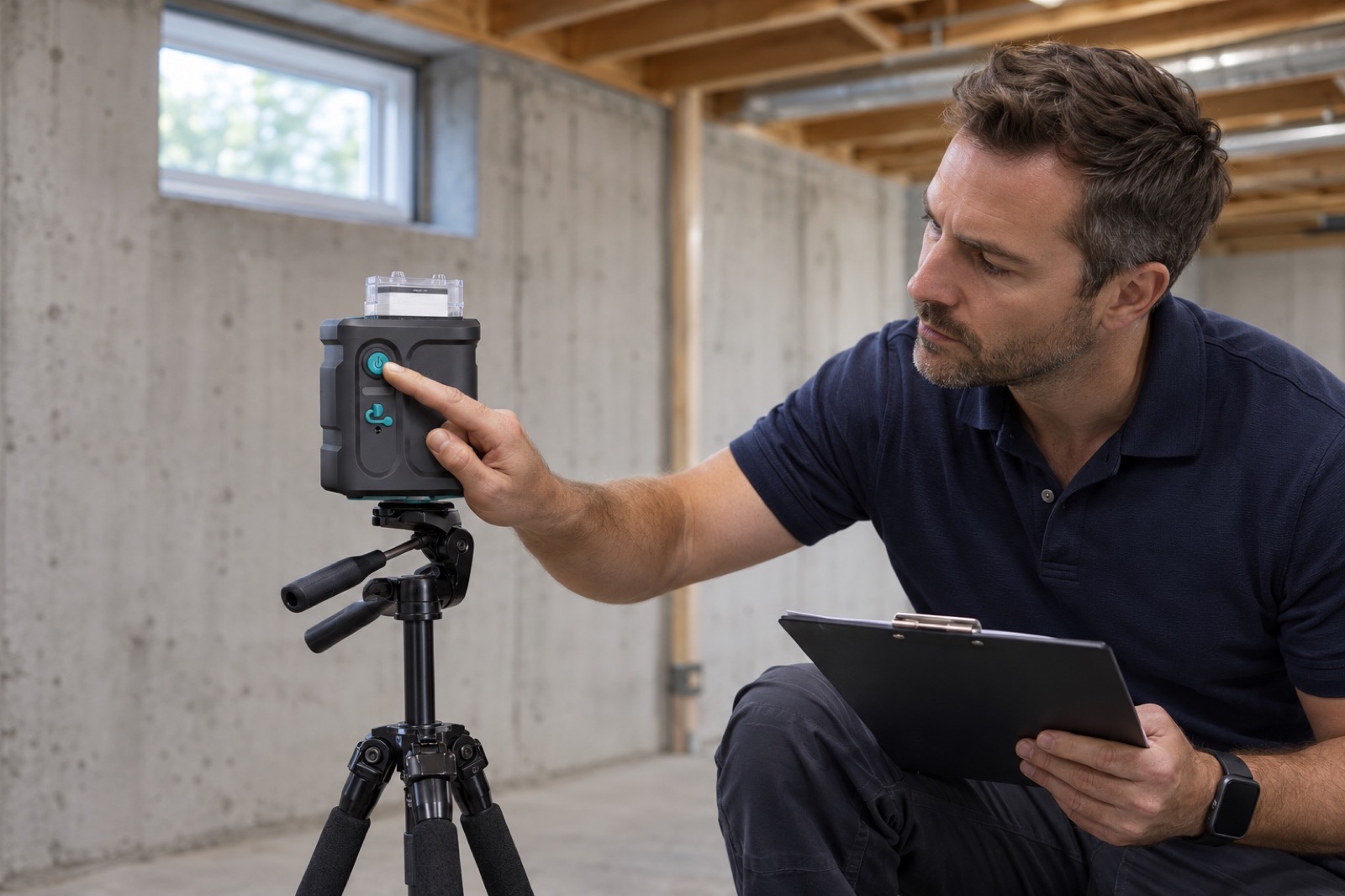
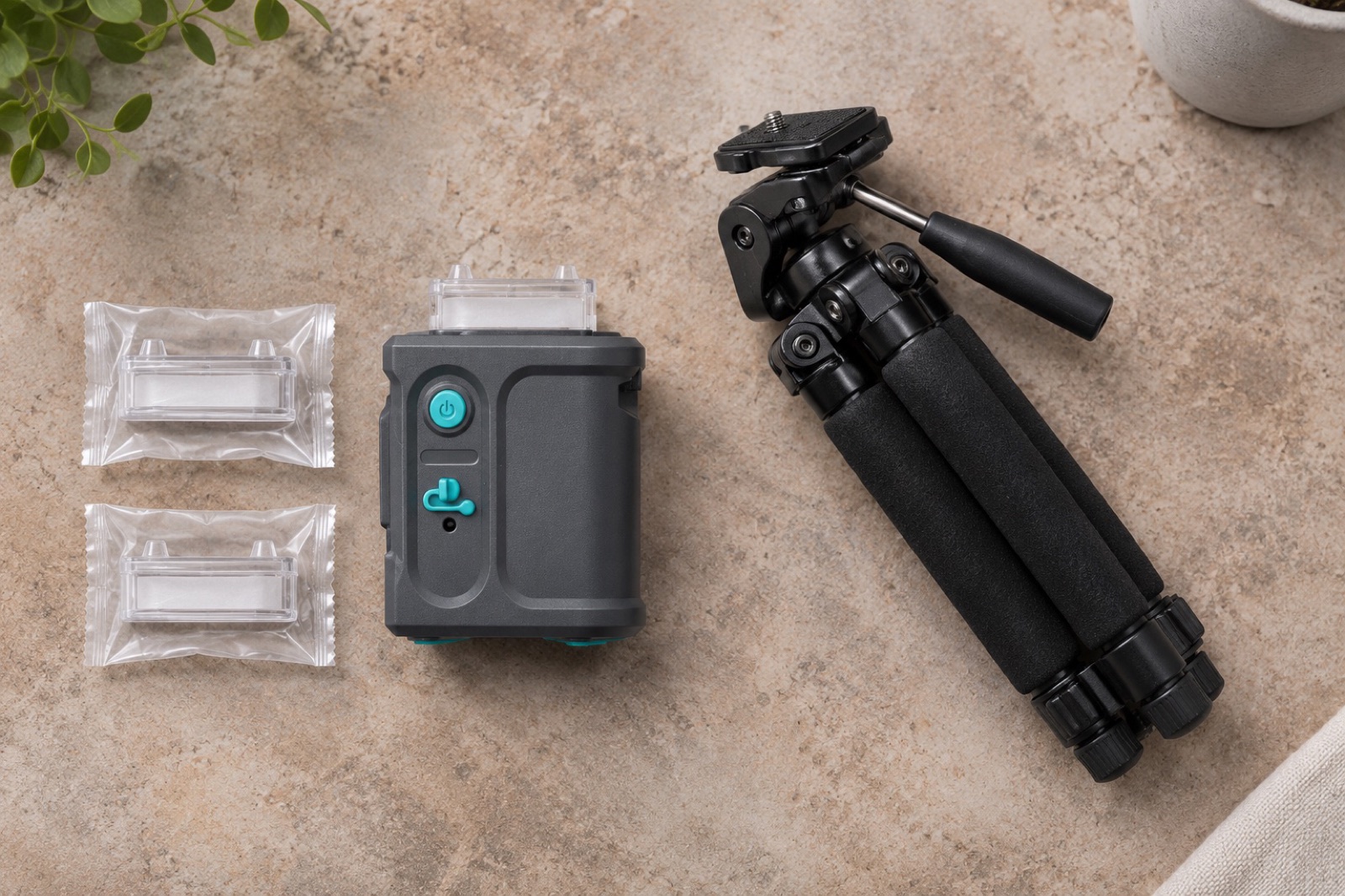
Description: Utilises a specialist air-sampling pump to capture circulating airborne mould spores within internal living spaces, combined with outdoor comparative air sampling where suitable. Collected samples are submitted to an accredited testing laboratory to evaluate spore concentrations and identify specific mould categories where viable.
Value: Surface swabs only identify mould DNA present on a targeted structural material; an air pump test directly evaluates the spores actively travelling through your indoor air. This provides essential diagnostic data when assessing suspected airborne mould issues, particularly when contamination is hidden and no visible mould has broken through onto surfaces.
This service can be beneficial when:
- Airborne mould contamination is suspected, but no growth is visibly detectable on walls or ceilings.
- Property occupants experience ongoing musty smells or unexplained respiratory discomfort.
- Indoor humidity, condensation, or defective mechanical extraction is an issue.
- Assessing living spaces following an escape of water, leak, or flood damage.
- Baseline air quality needs verifying prior to or following damp remediation works.
Note: Air pump analysis measures active spore levels at the specific time of collection. Diagnostic results are reviewed alongside exterior control samples, internal damp meter readings, ventilation performance and observed structural conditions. Survey fee credited when repairs are completed by us.
Laboratory Analysis of Plaster Samples
Price £299 + VAT
(The cost of this add-on is deducted from your repair bill if we carry out the recommended remedial works).
Small plaster samples are carefully taken from affected walls and sent to an independent laboratory to analyse the concentration of hygroscopic salts (chlorides and nitrates).
Why it matters: Hygroscopic salts are carried by ground moisture during rising damp and remain in plaster even after masonry dries.
Diagnostic value: Differentiates true rising damp from condensation, rainwater penetration, or temporary plumbing leaks.
Note: Salt analysis can be particularly helpful when moisture-meter readings alone do not provide a sufficiently clear diagnosis. It may assist in distinguishing possible rising damp from condensation, water penetration or residual contamination caused by a historic leak. The results are considered together with the moisture profile, construction of the building, external ground levels, condition of the damp-proof course and other survey observations. This is the only additional service requiring minor invasive work because physical plaster samples must be collected. If we undertake the recommended remedial work, the survey cost will be deducted from the cost of that work.
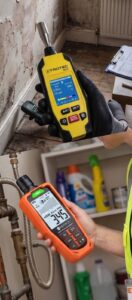
Gas, Vapour & Airborne Contaminant Screening
Price £299 + VAT
(The cost of this add-on is deducted from your repair bill if we carry out the recommended remedial works).
Comprehensive environmental air quality screening for properties with persistent odours, post-flood contamination, or air quality issues.
Screening includes:
- Indoor air-quality assessment – IAQ
- Volatile organic compounds – TVOC/VOC
- Formaldehyde – HCHO
- Fine airborne particles – PM1.0, PM2.5 and PM10
- Dust and smoke particles – PM1.0, PM2.5 and PM10
- Sewer gas screening – H2S, NH3 and CH4
- Flammable gas screening – CH4 and C3H8
- Carbon monoxide – CO
- Hydrogen sulphide – H2S
- Ammonia – NH3
- Oxygen levels – O2
- Stale-air and ventilation assessment – IAQ and TVOC
- Drain odour investigation – H2S, NH3 and CH4
- Chemical smell investigation – TVOC, VOC, HCHO and NH3
- Post-leak air and surface-condition checks – PM2.5 and TVOC
- Combustion gas screening – CO, O2 and CH4
- Building-product off-gassing assessment – TVOC and HCHO
- General pollutant screening – PM1.0, PM2.5, PM10 and TVOC
Diagnostic value: Pinpoints the source of foul drain odours, chemical off-gassing and stale air problems linked to poor ventilation. It is also useful when a property contains a persistent foul, stale or unexplained smell. Odours can originate from damp building materials, stagnant water, contaminated drains, sewer gases, mould-related conditions or chemical vapours. Targeted screening helps narrow down the possible source and supports further investigation.
Note: Screening results do not replace specialist gas, environmental or medical assessments where these are required. The survey charge will be deducted if London Damp Specialists completes the recommended remedial work.

Biological, Organic Contamination and Odour Detection Testing
Price £699 + VAT
Description: A specialist diagnostic testing service established to locate and identify biological deposits, organic residues and environmental contaminants across domestic and commercial premises. Samples are obtained via sterile surface swabs, targeted material sampling, or appropriate extraction techniques, followed by professional laboratory analysis.
Value: Uncovers concealed biological matter and hazardous organic residues that cannot be detected through visual inspection alone. Independent laboratory testing delivers definitive evidence regarding bodily fluids, waste ingress, bacterial risks and animal contamination, ensuring that decontamination and repair treatments are accurately targeted.
This service can be beneficial when:
- A property suffers from drainage failures, blackwater leaks, or soil pipe overflows.
- Persistent, unidentified, or foul organic smells cannot be resolved through basic cleaning.
- Pests or domestic animals have caused contamination inside sub-floor voids or roof spaces.
- Clear forensic confirmation of sanitary conditions is required after trauma or severe neglect.
- Landlords or property managers require certified laboratory proof before and after remedial decontamination.
Note: The designated testing method depends on the material investigated, the contaminated substrate and the necessary degree of laboratory identification. The survey fee is credited when repairs are completed by us.
Contact Us
If you have some questions, please complete this form:
Book and Pay for a survey
If you are ready to book a survey and pay, please complete this form:

Contact Us
If you have some questions, please complete this form:
Book and Pay for a survey
If you are ready to book a survey and pay, please complete this form:
Contact Us
If you have some questions, please complete this form:
Book and Pay for a survey
If you are ready to book a survey and pay, please complete this form: